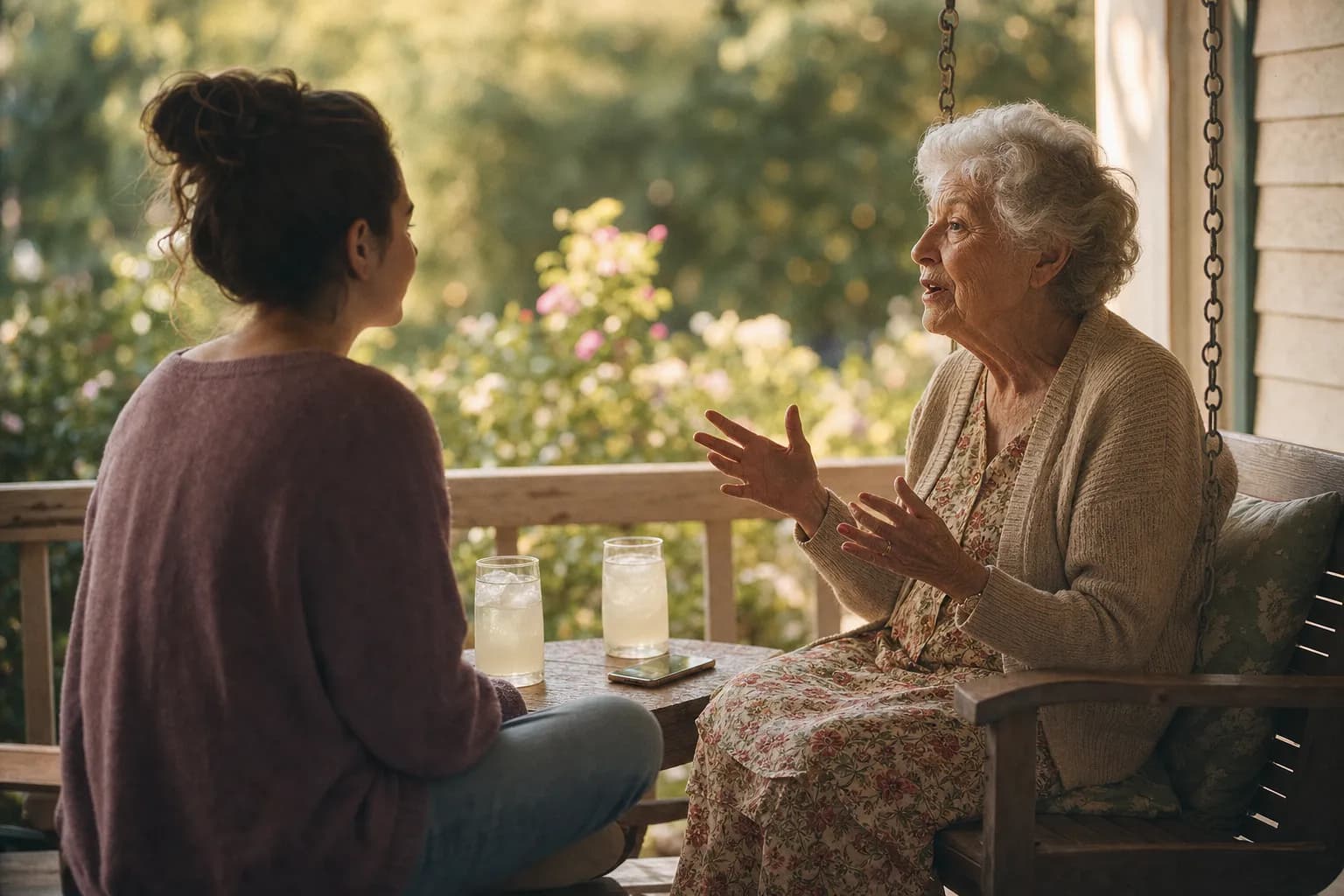

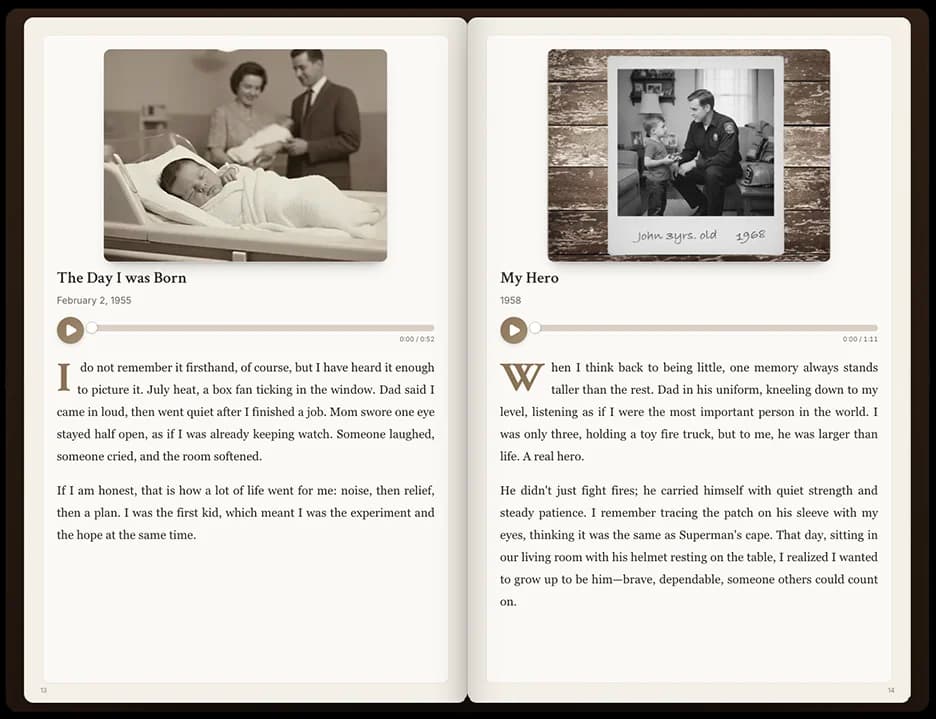
These are questions to ask your grandparents when you want to capture their stories, wisdom, and family history while you still can.
Quick Answer
Best questions to ask grandparents: Start with easy childhood questions ("What's your earliest memory?"), progress to family heritage and love stories, then deeper topics like life lessons and legacy. Use specific event-based questions over general ones — research shows 25-40% better recall with structured prompts, without increasing errors.¹
Critical timing: In our experience, most storytelling happens within a few years of major life events — and 47% of Americans regret not recording their loved ones' voices. Starting these conversations today matters more than perfecting your question list.²
Start with the easy ones, then work toward deeper conversations.
Childhood & Growing Up
Quick answer: Start with safe, nostalgic childhood questions—favorite toys, school memories, best friends—to help grandparents relax into storytelling mode.
Show 11 more questions
Family & Heritage
Quick answer: Ask about family origins, traditions, and ancestor stories—these connect grandchildren to roots and preserve cultural heritage across generations.
Why this matters: Research shows that children who know their family history have higher self-esteem and better resilience during stress.³ These stories shape identity across generations.
Show 9 more questions
Teen Years & Young Adulthood
Quick answer: Teen and young adult questions reveal formative experiences—first jobs, early dreams, and life-changing decisions that shaped who they became.
Show 11 more questions
Worried about what to say next?
Pearl, your Whisper Storyteller, asks the follow-up questions for you — gently, one at a time.
Sample conversationWhat was your childhood kitchen like?
Oh, always warm. My mother baked bread every Saturday…
What did the kitchen smell like on those Saturdays?
Yeast and coffee. I can still smell it.
Love & Marriage
Quick answer: Love story questions are often grandchildren's favorites—"How did you meet?" and "What's the secret to a long marriage?" capture relationship wisdom and romantic family history.
Show 9 more questions
Career & Work Life
Quick answer: Work questions uncover professional journeys, mentor relationships, and career lessons—often revealing unexpected skills and sacrifices that built family stability.
Show 9 more questions
Historical Events & World Changes
Quick answer: Historical questions connect personal stories to world events—turning textbook moments into lived experiences through your family's eyes.
Show 6 more questions
Life Lessons & Wisdom
Quick answer: Legacy questions about advice, regrets, and life philosophy capture timeless wisdom—often the most replayed recordings in families.
Show 10 more questions
About Me (and Other Grandchildren)
Quick answer: Personalized questions about grandchildren create intimate recordings that become treasured keepsakes—especially after grandparents pass.
Show 5 more questions
Fun & Favorites
Quick answer: Light "favorites" questions are perfect conversation starters and cool-down topics—keeping sessions fun when deeper topics feel too heavy.
Show 8 more questions
Tips for Asking These Questions
Quick answer: Start with easy warmups, let conversations wander naturally, record everything, and make storytelling regular—not a one-time event.
Need help recording? See our guide to recording family stories.
Start simple. The childhood questions are great warmups. Save the deeper questions about regrets and legacy for when you've built momentum.
Let them wander. If a question sparks a tangent, follow it. The unexpected stories are often the best ones. In our experience, the most meaningful family stories often emerge from unplanned tangents, not scripted questions.⁴
Record everything. Memories are precious. Don't trust them to your own memory alone. Memory fades quickly — we forget roughly half of new information within an hour without review.⁵
Make it regular. You won't cover all these questions in one sitting, and that's fine. Make it a recurring conversation. Families who record stories in multiple 30-45 minute sessions capture significantly more content than those attempting single marathon sessions.⁶
Include specific details. When they mention something, ask follow-ups: "What color was that car?" "How did that make you feel?" Details make stories come alive.
Related guides
- The best gift for grandparents (year-round)
- The best Mother's Day gift for mom
- 100+ Questions to Ask Your Grandma Before It's Too Late
- 100+ Questions to Ask Your Grandpa Before It's Too Late
- 100+ Questions to Ask Your Mom Before It's Too Late
- 100+ Questions to Ask Your Dad Before It's Too Late
- 100+ Questions to Ask Your Aunt
- 100+ Questions to Ask Your Uncle
- 100+ Questions to ask a veteran about their service
- Recording your grandparents' stories
- Recording your parent's stories
- Urgent story preservation
- Family legacy preservation guide
- How to save old photo albums
You have the questions. Now you need 10 minutes and a phone. Heritage Whisper turns those answers into a searchable, shareable family archive, automatically transcribed and organized by decade. Your grandchildren will be able to hear these answers long after you've forgotten you asked them.
Sources:
- Cognitive Interview Research — "The Cognitive Interview enhances long-term free recall of older adults," Psychology and Aging, 2006
- Memorial Merits Survey — 47% of Americans regret not recording loved ones' voices
- Emory University "Do You Know?" Study — Dr. Marshall Duke & Dr. Robyn Fivush: family history knowledge is the best single predictor of children's emotional health
- Frontiers in Psychology — "The role of intergenerational family stories in mental health and wellbeing," 2022
- Ebbinghaus Forgetting Curve — established psychology: memory fades ~50% within an hour without review
- StoryCorps — 645,000+ participants since 2003, uses 40-minute interview sessions
- U.S. Census Bureau — approximately 10,000 Americans turn 65 every day (cited in Quick Answer)
Frequently Asked Questions
What are the best questions to ask grandparents?
Start with easy childhood questions like 'What's your earliest memory?' and 'What games did you play as a kid?' Then progress to family heritage, love stories, career memories, and life lessons. Research shows specific event-based questions produce 25-40% better memory recall than general ones like 'Tell me about your life.'
How do I start a conversation with my grandparent about their past?
Begin with something tangible — an old photo, a family recipe, or a holiday memory. Ask 'Tell me about this photo' or 'How did you make this recipe?' These concrete starting points are much easier than abstract questions and naturally lead to deeper stories.
What should I ask my grandparents before they die?
Prioritize three areas: their childhood and family origin stories, their love story (how they met, married, built a family), and their biggest life lessons or advice. These are the stories most often regretted as lost. Even 10 minutes of recording on these topics creates irreplaceable family history.