


If you're reading this, you're probably here because time is short. Or you're worried it will be soon.
This guide is for that moment. It's organized so you can pick up the questions that matter most, in the time you have, without having to read the whole thing.
The hardest part is starting. Once you start, the questions ask themselves.
Quick Answer
Most important questions to ask a dying parent, in priority order:
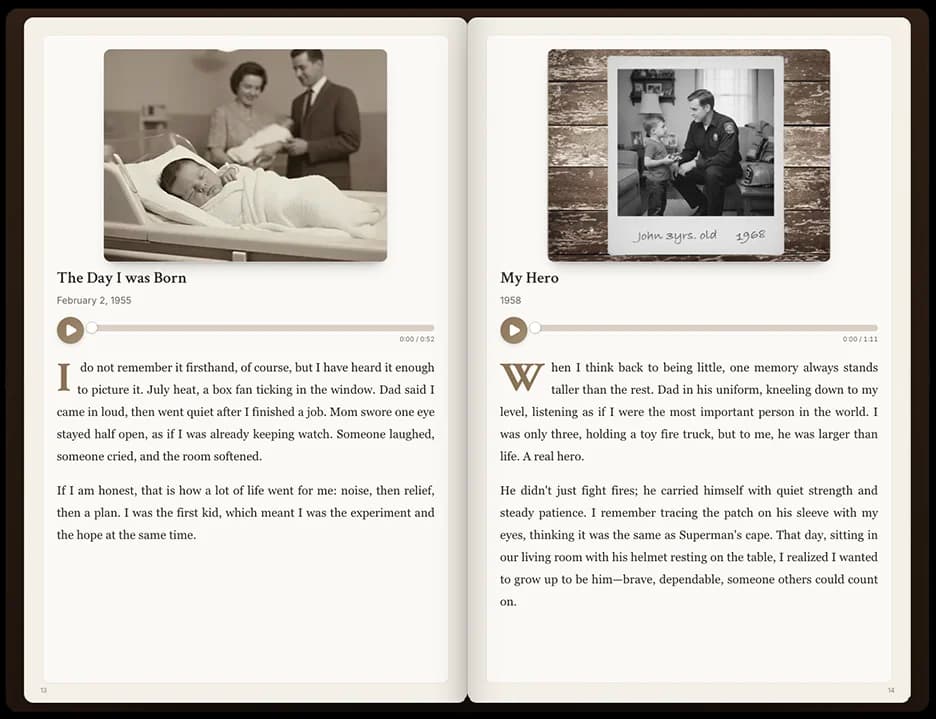
- "What was the day I was born like for you?"
- "What do you want me to remember about your own mom or dad?"
- "What's something you've never told me that you want me to know?"
- "What do you most want me to remember about you?"
- "Is there anyone you'd want me to thank or talk to for you?"
If you only have 15 minutes, ask these five. They answer most of the regrets adult children report after a parent dies.
| Time you have | What to ask |
|---|---|
| 15 minutes | The five priority questions above |
| 1 hour | Add: their childhood, love story, one regret, one piece of wisdom |
| A few days | Add: their own parents, faith, what they're proud of, what they've forgiven |
| A week or more | The full list below — in 30-45 minute sessions, not marathons |
Record everything. 47% of Americans regret not recording their loved ones' voices.¹ The single thing adult children most often wish they had after a parent dies is the sound of their voice telling a story.
If your parent's health is declining and you need a step-by-step guide to recording, see Recording a Dying Parent's Stories.
Before You Begin: A Note on Timing and Tone
This is emotionally heavy work. A few things to hold onto:
Frame the conversation around legacy, not mortality. Try: "I realized I don't have many of your stories on tape — would you tell me some?" Avoid "before you go." Most parents respond more openly when the focus is on what they're leaving behind, not what's ending.
Keep sessions short. 15-20 minutes is plenty for early sessions, especially if energy is low. You can always come back tomorrow. Families who spread these conversations across multiple short sessions capture significantly more than those who attempt single long interviews.²
Permission first. Ask: "Is it OK if I record this? I'd love to be able to play it back for my kids someday." Most parents say yes. The framing of "for the kids" or "for the family" lowers the resistance.
You don't have to ask the hard questions today. Start where it feels comfortable. The deeper conversations almost always emerge on their own once your parent feels heard on the easier ones.
If You Have 15 Minutes — The Essential Five
Quick answer: If you only have one short window, ask these five questions. They cover love, generational memory, secrets, legacy, and unfinished relationships. Together they answer most of what adult children report wishing they had asked.
- "What was the day I was born like for you?"
- "What do you want me to remember about your own mom or dad?"
- "What's something you've never told me that you want me to know?"
- "What do you most want me to remember about you?"
- "Is there anyone you'd want me to thank or talk to for you?"
That's a 15-minute conversation. Record it. Even if it's the only one you ever capture, it's irreplaceable.
If You Have an Hour — A Deeper Set
Quick answer: Add questions about their childhood, their love story, one regret they've made peace with, and one piece of wisdom they want to pass on.
After the priority five, add:
Show 4 more questions
That's about an hour, if your parent is comfortable. Don't push past their energy. Two 30-minute sessions is better than one 60-minute one when health is fragile.
If You Have Days or Weeks — The Full List
Quick answer: Spread the conversations across multiple short sessions, organized by theme. Start with their childhood and family, move into love and parenthood, then faith and legacy. Save the heaviest questions for after they've relaxed into the project.
Use the sections below as a menu, not a checklist. Pick what feels right today. You can always come back.
Their Childhood and Family Origin
Quick answer: Childhood questions are the warmest entry point — low-stakes, nostalgic, and they often unlock memories your parent hasn't visited in decades.
Show 7 more questions
If you want a longer list specific to a parent, see:
Worried about what to say next?
Pearl, your Whisper Storyteller, asks the follow-up questions for you — gently, one at a time.
Sample conversationWhat was your childhood kitchen like?
Oh, always warm. My mother baked bread every Saturday…
What did the kitchen smell like on those Saturdays?
Yeast and coffee. I can still smell it.
Their Own Parents (Your Grandparents)
Quick answer: Questions about your parent's own mom and dad are some of the most emotional and most overlooked. They reveal where your parent learned to be a parent — and what they chose to keep or change.
Show 8 more questions
These questions matter more than they look. They're often the bridge to the deeper, harder ones below.

Their Love Story
Quick answer: The story of how your parents met and built a life together is one your kids will play back forever. Ask for the real version, not the polished one.
Show 5 more questions
If your parent has lost their spouse, these questions can be especially important — and especially tender. Move at their pace.
Becoming a Parent (Your Origin Story)
Quick answer: Most adult children never ask their parents about the day they were born from their parents' perspective. Ask. It's almost always emotional, and almost always the recording your siblings will replay.
Show 6 more questions
Faith, Death, and What Comes After
Quick answer: These are the questions many parents most want to be asked at this stage of life — and the ones their kids most often hesitate to bring up.
Ask permission first: "Is it OK if we talk about faith and what you believe is next? You can pass on anything." Then listen.
Show 5 more questions
These don't have to be solved. They just have to be asked and listened to.
Forgiveness, Regret, and Reconciliation
Quick answer: This section is heavy. Save it for a session when your parent has energy. Some answers are gifts. Some are repairs. Both matter.
Show 5 more questions
These conversations can be hard. They are also some of the most healing conversations families ever have. Adults with recorded family conversations report better grief processing and less regret than those without recordings.³ The act of asking, and the act of being asked, both matter.
What They Want You to Know
Quick answer: These are the legacy questions. Save them for your most settled session.
Show 6 more questions
Questions for a Parent Who Can't Speak Easily
Quick answer: When energy or speech is limited, switch to yes/no questions, photos, and physical anchors. Even brief vocalizations are precious. Just being there is also enough.
If your parent is in late-stage illness, hospice, or simply too tired:
- Hold their hand and show them an old photo. Ask, "Was this your favorite chair?" or "Is this the house you grew up in?"
- Ask yes/no questions: "Did you love being a parent?", "Was Mom/Dad your great love?"
- Play music from their youth and watch their face. Recordings of recognition are gifts.
- Read aloud to them. Old letters they wrote. Cards from the kids. Their favorite poems.
- Tell them what they've meant to you. You don't need them to answer. Some of the most treasured recordings families have are the parent's voice on a normal phone call, captured by accident — or the adult child's voice telling them they're loved, with their parent's quiet breathing in the background.
What matters is being there. Recording captures the gift; presence is the gift.
The Question That Often Goes Unsaid
Quick answer: The question many parents most want their adult children to ask is also the one most adult children find hardest. It's worth asking anyway.
"Are you scared?"
Or, if that's too direct: "How are you doing — really?"
Most adult children don't ask this because they're afraid of the answer, or afraid of breaking down. Their parent often is, too. Asking it gently — and being willing to sit with whatever answer comes — is one of the kindest things you can do at this stage.
You don't have to fix anything. You just have to listen.
Tips for Asking These Questions Gently
Quick answer: Ask permission, keep sessions short, follow the tangents, and don't be afraid of pauses.
Ask permission once. "Would it be OK if I asked you some questions about your life and recorded them? Just for me and the kids." Most parents say yes. After that, you don't need to keep asking.
Keep sessions short. 15-20 minutes is plenty. You can come back tomorrow. Families who record across multiple short sessions capture more meaningful content than those who attempt single long interviews.²
Follow the tangents. If a question sparks an unexpected story, follow it. The tangents are often the best part.
Don't fear the pauses. Long silences are normal and often mean the most important answer is coming. Wait.
Record everything. Phone audio is fine. Tools like Heritage Whisper transcribe and organize automatically. Memory fades roughly 50% within an hour without review.⁴ Don't trust your own memory to hold these stories.
It's OK to cry. It's OK if your parent cries. Tears are not a reason to stop. They're often a sign you're in the most important part of the conversation.
You can repeat questions. If a question got a short answer last week and your parent seems more rested today, ask it again. The fuller answer often comes the second or third time.
What to Do With the Recording After
Quick answer: Back it up immediately, share it with siblings, and revisit it after the funeral — not before.
- Back up the recording the same day. Cloud storage, email it to yourself, save it in two places. The single biggest preventable loss is a phone that breaks before the file is backed up.
- Transcribe it. Tools like Heritage Whisper transcribe automatically; if you used a phone voice memo, services like Otter or Descript do the same. The transcript becomes searchable.
- Share with siblings. Let them hear what their parent said. Often this becomes a way to grieve together later.
- Don't replay it right away. Many adult children find the recording too painful in the first weeks after a death. Save it. It will be there when you're ready, and it will be more meaningful then.
- Replay it on anniversaries. Birthdays, holidays, the anniversary of their death. The recording becomes a way for your kids to know who their grandparent was.
Related Guides
- Recording a Dying Parent's Stories: A Complete Guide
- Urgent story preservation: when time is short
- 100+ Questions to Ask Your Mom
- 100+ Questions to Ask Your Dad
- 100+ Questions to Ask Your Grandparents
- 100+ Questions to ask a veteran about their service
- Family legacy preservation: the complete guide
You don't have to ask all of these questions. You don't have to do this perfectly. The single most meaningful thing you can do today is ask one question, hit record, and listen.
Heritage Whisper turns those answers into a searchable, shareable family archive — automatically transcribed, organized by chapter, and shared instantly with every family member. Your kids will be able to hear your parent's voice answering these questions long after they're gone.
Sources:
- Memorial Merits Survey — 47% of Americans regret not recording loved ones' voices
- StoryCorps — 645,000+ participants since 2003, with sessions averaging 40 minutes
- Oral histories and grief processing — research linking recorded family conversations with improved grief outcomes
- Ebbinghaus Forgetting Curve — established psychology: memory fades approximately 50% within an hour without review
- Cognitive Interview Research — Specific event-based questions produce 25-40% better recall than open prompts
- Emory University "Do You Know?" Study — Family history knowledge is the strongest single predictor of children's emotional health
Frequently Asked Questions
What are the most important questions to ask a dying parent?
Five questions matter most: 'What was the day I was born like for you?', 'What do you want me to remember about your own mom or dad?', 'What's something you've never told me that you want me to know?', 'What do you most want me to remember about you?', and 'Is there anyone you'd want me to talk to or thank for you?' These five answer most of the regrets adult children report after a parent dies. Even if you only have 15 minutes, ask these.
How do I bring up these questions without upsetting my parent?
Frame the conversation around legacy, not mortality. Try 'I realized I don't have many of your stories on tape — would you tell me some?' or 'I want my kids to hear your voice telling these stories someday.' Avoid 'before you go' or 'while we still can.' Most parents respond well when the focus is on what they're leaving behind, not what's ending. Keep first sessions to 15-20 minutes; you can always come back.
What if my parent is too weak or in too much pain to talk?
Switch to yes/no questions about photos and objects. Hold their hand and ask 'Is this the house you grew up in?' or 'Was this your favorite chair?' Even brief vocalizations and looks of recognition are precious. If they can't speak at all, sit with them and tell them what they've meant to you. Some of the most treasured family recordings are not interviews — they're the parent's voice on a normal phone call, captured by accident.
Should I record these conversations?
Yes, almost always. Memory fades, and adult children consistently report that what they wish they had most after a parent dies is the sound of their parent's voice telling a story. A phone voice memo or a tool like Heritage Whisper costs nothing and creates a recording your family will replay for decades. Ask permission, hit record, and let the conversation be a conversation — not a formal interview.